Why Smart Promoters Are Ditching Spreadsheets Before They Get Left Behind
Austin, United States - January 13, 2026 / Prism.fm /
Independent promoters who automate their workflows will outpace competitors still trapped in manual processes.
The music promoter software market is growing at nearly 18% annually as venues abandon spreadsheets for specialized tools.
Automation eliminates the administrative bottlenecks that prevent small operations from scaling.
Real-time financial visibility transforms reactive decision-making into strategic planning.
2026 marks the tipping point where manual operations become competitively unsustainable.
If your booking workflow still lives in email threads and Excel, the clock is ticking.
There's a moment every independent promoter knows too well. It's 2 AM after a sold-out show, and instead of celebrating, you're hunched over a laptop reconciling ticket counts against a spreadsheet that someone accidentally overwrote three versions ago. The artist's manager is waiting on a settlement. Your co-promoter partner needs their split calculated. And somewhere in your inbox, there's a hold request that's about to expire because you forgot to follow up.
This isn't a worst-case scenario. For thousands of independent concert promoters, it's Tuesday.
The global event management software market is projected to surge from $15.5 billion to $34.7 billion by 2029, driven largely by operators who've realized that manual processes are inconvenient and expensive. For independent promoters competing against well-resourced national players, adopting live music promoter tools is about survival.
Why Are Manual Systems Breaking Down?
The live music industry has changed, but many independent operators are still running their businesses like it's 2015. Shows have gotten more complex. Artist deals have gotten more complicated. And the margin for error has gotten razor-thin.

Consider the typical independent promoter workflow. Booking requests come in via email, text, and Instagram DMs. Hold information lives in a shared Google Calendar that three people update inconsistently. Deal terms are scattered across email threads, and finding the right version of a contract requires excavation through your inbox. Financial tracking happens in Excel files that have grown so unwieldy they take ten seconds to load.
This fragmentation creates problems that compound over time. Double-bookings happen when calendar updates don't sync. Settlements get delayed because expense tracking is a mess. Offers expire because follow-ups slip through the cracks. Each individual failure might seem minor, but the cumulative effect is an operation that can't scale beyond a certain number of shows per year without adding headcount that the margins won't support.
The music industry's appetite for streamlined operations is driving rapid adoption of purpose-built tools that understand the specific workflows of concert promotion. Generic project management software doesn't cut it when you need to track percentage deals, co-promotion splits, and settlement calculations that are unique to live entertainment.
What Does Automated Event Planning Actually Deliver?
When promoters talk about automation, they're describing software that handles the repetitive tasks that consume hours every week. The real value of show organizer software is freeing up time for the decisions that require expertise.
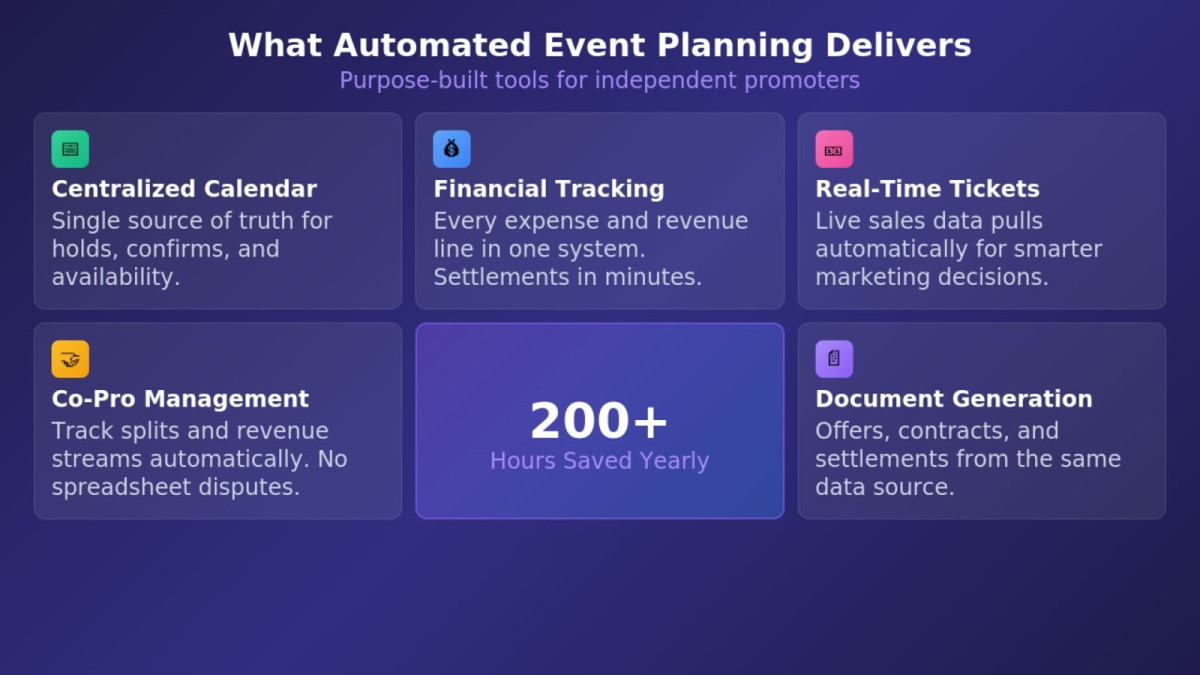
Centralized calendar and hold management. Instead of juggling multiple calendars and hoping everyone stays updated, modern platforms provide a single source of truth for availability. When a hold is confirmed or released, everyone with access sees the change immediately. No more conflicting information causing embarrassing double-booking situations.
Automated financial tracking. Every expense, revenue line, and ticket sale flows into one system. When settlement time arrives, the calculations are already done. Promoters who've made the switch report that settlement processes that once took hours now take minutes.
Real-time ticket integration. Instead of manually checking ticketing dashboards and updating spreadsheets, automated systems continuously pull in sales data. This visibility transforms how promoters approach marketing spend. When you can see ticket velocity in real-time, you know exactly when to push harder on promotion and when to ease off.
Co-promotion deal management. Partnership deals are increasingly common as promoters share risk on bigger shows, but tracking split percentages across multiple revenue streams is a spreadsheet nightmare. Purpose-built independent concert tools automatically handle these calculations, eliminating the disputes and delays that damage professional relationships.
Document and contract generation. Offer letters, contracts, and settlement sheets generated from the same data ensure consistency and reduce the manual work of creating documents from scratch for every show.
What Is the True Cost of Staying Manual?
The hidden expense of manual operations is the opportunities that never materialize because you're too buried in busywork to pursue them.
Every hour spent reconciling spreadsheets is an hour not spent building relationships with agents. Every settlement delay strains artist relationships and makes you a less attractive partner for future dates. Every missed hold follow-up is a show that went to a competitor who responded faster.
There's also the error cost. Manual data entry inevitably produces mistakes. A misplaced decimal point in a settlement calculation can cost thousands. A forgotten expense line can turn a profitable show into a loss on paper. These errors erode trust with artists, agents, and venue partners, relationships that take years to build.
Staff can save one to two hours daily when automation handles repetitive tasks. For an independent promoter, that's potentially 200+ hours per year redirected from administrative grind to revenue-generating activity.
Why Is 2026 the Tipping Point for Automation?
Several factors make 2026 the year when manual operations become competitively untenable.
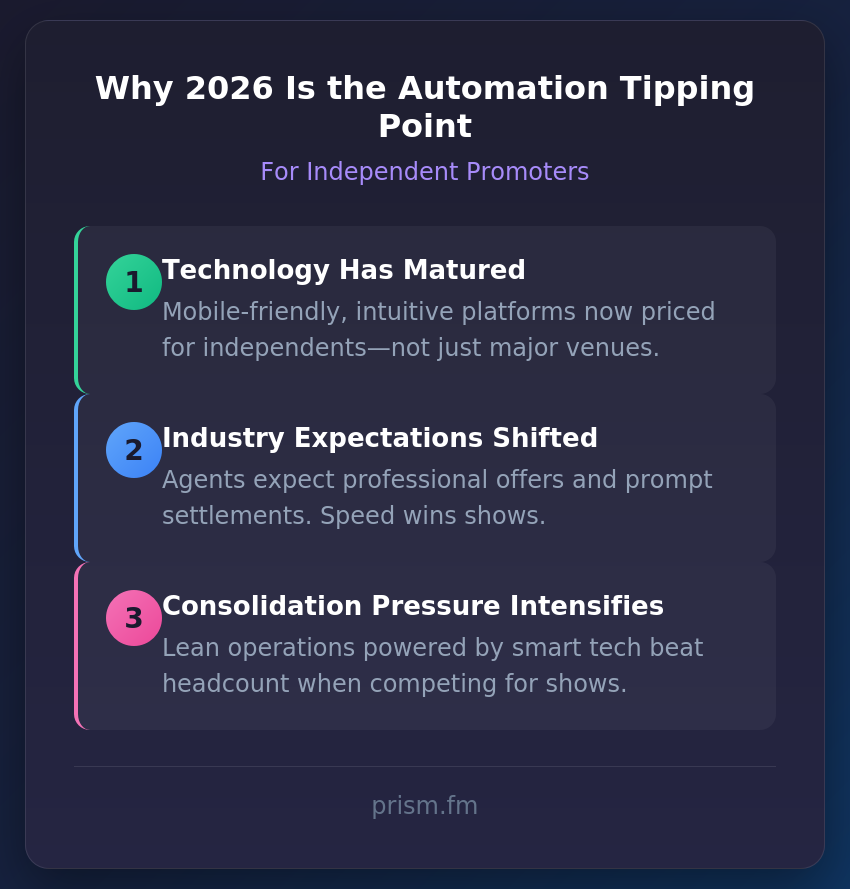
First, the technology has matured. Early live music promoter tools were clunky, expensive, and came with a high learning curve. Current platforms are mobile-friendly, intuitive, and priced for independent operators rather than just major venues.
Second, industry expectations have shifted. Agents and managers expect professional-looking offers and prompt settlements. When your competitors deliver clean, data-backed offers within hours while you're still pulling numbers from three different spreadsheets, the perception gap becomes a business liability.
Third, the consolidation pressure from major promoters continues to intensify. Independent operators need every efficiency advantage to compete for shows against companies with deeper pockets. The promoters who will thrive are those who run lean operations powered by smart technology rather than headcount.
FAQs
What are live music promoter tools? Live music promoter tools are specialized software platforms designed to streamline booking, financial tracking, calendar management, and settlements for concert promoters and venue operators. Unlike generic event software, these tools understand music industry workflows like percentage deals, co-promotion splits, and artist settlements.
How does automated event planning save time for independent promoters? Automated event planning eliminates manual data entry, generates documents from existing information, and centralizes communication across teams. Promoters typically recover 5 to 10 hours weekly by automating tasks like settlement calculations, calendar updates, and expense tracking.
What's the difference between show organizer software and generic event management platforms? Show organizer software is built specifically for live entertainment workflows, including features like ticketing integration, co-promotion deal management, and music industry-standard settlement processes. Generic platforms lack these specialized capabilities and often require workarounds that create inefficiency.
Why should independent promoters invest in software now rather than waiting? The industry favors promoters who can respond quickly to opportunities and maintain professional operations. As expectations rise and major promoters leverage technology advantages, independents without automated systems will struggle to compete for quality shows and maintain artist relationships.
Making the Transition Without Disrupting Operations
The shift from manual to automated workflows doesn't have to be dramatic. Most successful transitions happen incrementally. Start by moving your calendar and hold tracking into a centralized system. Once that's stable, integrate financial tracking. Then add offer generation and settlement tools.
The key is choosing a platform built specifically for live music rather than adapting generic event software. The nuances of artist deals, co-promotion arrangements, and settlement calculations require specialized functionality that general-purpose tools don't provide.
Look for systems that integrate with your existing ticketing platform. The real-time sales data flowing directly into your management system eliminates manual data entry and provides the visibility needed for smarter promotional decisions.
Prism offers exactly this kind of purpose-built solution for independent venues and promoters, with features designed around how live music professionals actually work. If 2026 is going to be your breakout year, the foundation you build now determines whether you're leading the pack or scrambling to catch up.


Contact Information:
Prism.fm
5323 Levander Loop
Austin, TX 78721
United States
Matt Ford
https://prism.fm/

